Alpha is always temporary & derived from asymmetric information.
I grew up in B2B SaaS land and over the years I've seen seasons of some method, tech, or tactic go from being bleeding edge to industry standard.
Someone does something contrarian or experiments with a novel take on an old tactic, takes real risk on it, and gets results before everyone else catches on.
Whether it be signal based outbound or the modern data stack, it's a temporary advantage to get outsized returns on investment and capture market share.
What used to feel like a multi-year season is shrinking into months or weeks now. The average opening for an alpha window is closing faster than ever as the time to consume + act on information compresses.
Alpha will always exist, but capitalizing on it is more a function of composability than budget or headcount.
A quick history
This is a selective history from memory (aka I checked the dates but it's not exhaustive). These waves are reference points that overlap.
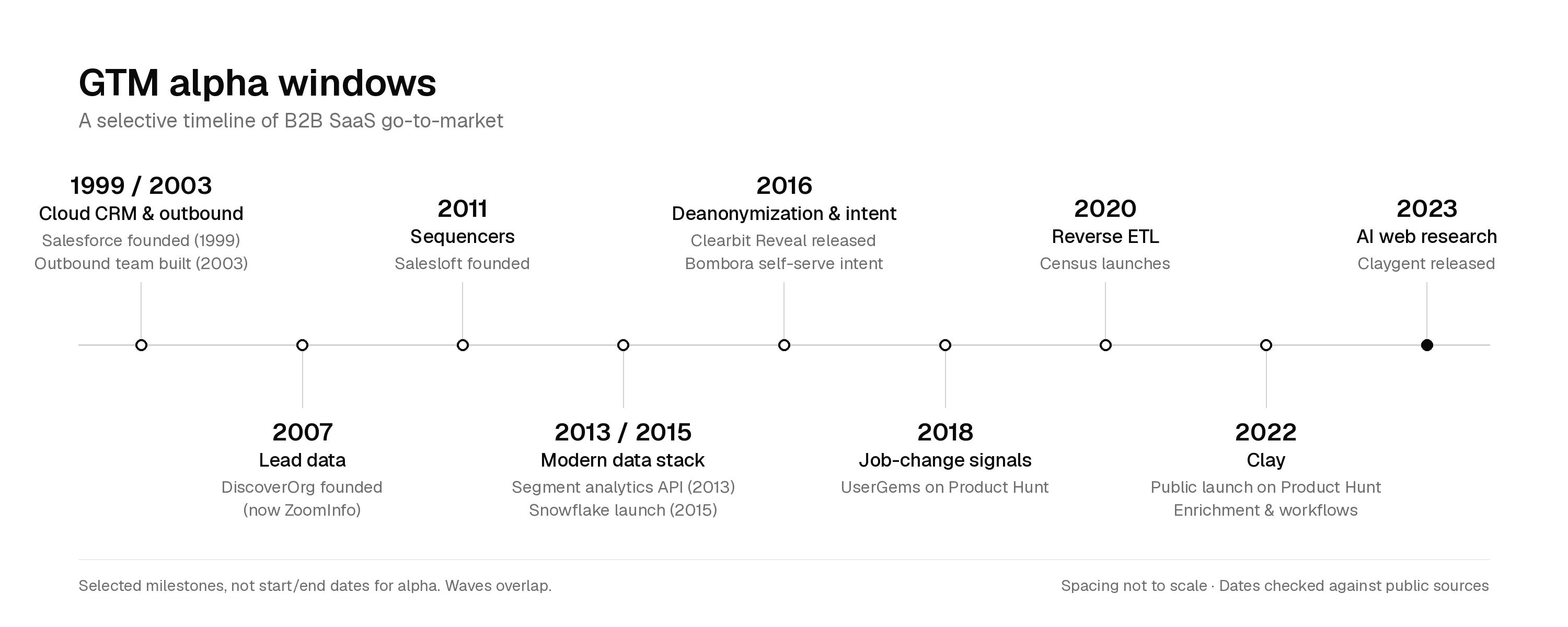
- Cloud CRM and Predictable Revenue. Salesforce was founded in 1999 and started building its outbound team in 2003. Shared customer data, formalized prospecting and specialized roles changed how teams operated. The book came out in 2011, years after the practice.
- Lead data and the sequencer. Lead databases were already part of the stack before the sales-engagement wave. DiscoverOrg -> ZoomInfo, was founded in 2007. Salesloft and Outreach's predecessor were founded in 2011. Sequencing turned one-off emails into repeatable multi-step outreach. Blast cannon activated
- The modern data stack. Segment's analytics API appeared in 2013 and Snowflake's warehouse launched in 2015. Later, reverse ETL tools like Census in 2020 brought warehouse data back into the tools reps used.
- Deanonymization and intent. Clearbit Reveal and Bombora's self-serve intent data both arrived in 2016. Knowing which companies were on your site, paired with gifting, was one window.
- Point solutions for signals. Job-change tracking (UserGems), packaged a specific signal into a point solution. Teams could buy signals rather than build the collection themselves.
- Clay, waterfalls and web research. Clay launched publicly in February 2022. Waterfall enrichment let teams check providers in sequence until one returned the data they needed. Claygent followed in 2023 for AI web research. Scraping wasn't unique to Clay. At Kandji, one application was scraping job postings to identify companies using Apple devices. These tools also let teams combine enrichment, research and actions across a workflow, building on cross-tool automation that already existed through tools like Zapier, launched in 2012.
- Agents and natural language coding. Agents can now take action on unstructured data, not just enrich rows. Opus 4 and Claude Code, both released in May 2025, made it practical for non-devs to work directly against APIs in plain English. That redefines how you build your tech stack because switching costs drop dramatically when you can rewire a workflow yourself (composability). At the same time, AI is pushing down the cost of building software, which makes vendors cheaper and easier to experiment with.
What differentiated teams always becomes part of the standard stack.
Why windows are getting shorter
Two vectors.
(1) Information velocity
How fast a working tactic spreads from the team that found it to everyone else.
Predictable Revenue was a practice for years before it was a book. Today an experiment can become a LinkedIn post, a template, a YouTube walkthrough and a paid class within weeks. Content creation as a growth lever for companies and business for individuals has massively increase supply. AI makes it even easier to summarize, remix and distribute.
(2) Tool velocity
How fast someone else can rebuild what you built.
Part of the early edge is usually that something is hard to build. AI reduces the work required to collect data, write logic and connect tools, so competitors can reproduce a workflow much faster. Switching costs have dropped. When you can rewire a workflow yourself and new vendors keep getting cheaper to try, nobody stays locked into the old way for long.
Both vectors also create new windows. New tools make things possible that weren't before, and cheaper software plus lower switching costs make it easier to try them. More experimentation creates more opportunities to discover something useful. The windows get shorter, but there are more of them.
My heuristic for a window closing is much like a hyped stock. Once everyone's talking about it, it's probably over.
From alpha to best practice
As an approach becomes widely accessible and adopted, it can become a best practice or a standard. It still works. Adopting it just stops producing the same advantage, and the difference shifts to how well you execute it.
Speed to lead is a good example. Early at Kandji we automated qualification and responses to inbound leads without AI:
- Qualify firmographically on form submit with an enrichment API, something like ZoomInfo FormComplete.
- Dynamically serve the post-submission page based on that qualification including industry/vertical specific and job title specific talk tracks.
- Use branched declarative logic to decide which sequence or email follow-up each lead received.
From what I saw, speed to lead in minutes was solvable by 2022 at the latest and is table stakes now. The real measuring stick now is the quality of the personalized follow-up across multiple dimensions (medium like call/text/email, content, relevance of person following up)
Once the mechanics are solved, the alpha moves up a layer. Speed was the edge, then it became the floor, and now the edge is in what you do with that speed.
The window on speed to lead closed. The window on quality is still open, and it'll close too. The teams that win are already looking for the next one.
Alpha windows today
If windows are getting shorter but more frequent, the advantage goes to whoever can catch the most of them. That comes down to composability.
Composability
How easily you can swap, recombine or redeploy the parts of your GTM system: tools, AI and people.
- Tools: Swap a data source, update the logic behind a signal or change the workflow that follows it without rebuilding everything.
- AI (harnesses & models): The harness and the model can change too. You aren't locked into one vendor's agent or one model, so you can use whatever is best for the job right now.
- People: Deploying humans is much more dynamic now. AI gives everyone a baseline of knowledge, so people can move into new domains faster than before.
The more composable your system is, the faster you can act on new information.
Four foundations
Each one makes part of the system easier to swap or change without starting over.
- Orchestrators. A layer like Clay or Cargo that connects the data, the context and the actions. They are already considered a "best practice" tech stack component, but are worth listing because they enable composability.
- Unbundled data. Data has evolved from one vendor contract to a layer you assemble from many APIs. You save on costs because you can switch APIs when a provider raises prices or slips on quality. You get better coverage with waterfall enrichment (whether it be Clay's waterfalls, a tool like waterfall.io, or an in-house version). And you get new kinds of data, like signals from TAMradar or scraping with Apify.
- Context operating systems. One place that holds what your company knows about its customers, positioning and canonized definitions so agents and workflows can use it. This could be a GitHub repo or a tool like Octave.
- Custom UIs on reliable infrastructure. Keep Salesforce (and similar enterprise quality platforms) for its robust API and database, then build your own interface for the rep's workflow. Fully headless sounds clean, but it assumes reps know where to start. A custom UI tells them what to look at and what to do next, and you can change all the data and logic powering scoring/recommendations underneath without another enablement cycle.
All four lower the cost, time and risk of changing your system and help you get the most out of your data. The easier your system is to change, the more windows you can catch.
Principles for catching more windows
You can't control when alpha windows open. But you can control how many you're positioned to catch.
1. Buyer psychology
Obvious, but always start with where your buyers are and how they behave, not with the tools. I like to build a matrix segmenting accounts by lifecycle stage (resource) with contact personas. Then find the bottleneck. Is the problem figuring out who to talk to, getting them to respond or getting them deeper into the funnel? Point your experiments there.
2. A core tech stack that enables composability
Shorter windows make vendor lock-in way more expensive. Flexible contracts, portable data and an orchestration layer you control matter a lot more than they used to. A few years ago, consolidating your stack into one platform felt smart. Now the pendulum feels like it's swinging back to best-of-breed plus orchestration. I'd rather pay a 20–30%+ premium for monthly than be stuck for 6 to 12 months. Opportunity cost vs freedom tax.
3. Data foundations
Unbundled data is only useful if it lands somewhere clean. Beyond the obvious (enrichment, identity resolution, account hierarchies, deduping), creating a unified signal table that standardizes outputs from the different data providers will be the clean fuel for the rest of your engine. This plus your semantic layer enables every agent and workflow to read the data the same way. (i learned most about this from the gtm eng lab and Reforge's AI Growth course)
4. A culture of experimentation
Ideally, try something new every 1 to 2 weeks. Stay engaged with what other people in growth and GTM engineering are doing, but most of the time alpha comes from your own first-party data & customer knowledge.
Evaluate against your own baselines, like customer acquisition cost or channel-specific metrics such as response rate or click-through rate. I'm not committed to a universal number that tells you you've found a window. Benchmark against your other channels and other tactics within the same channel, then weigh the results against how much capacity it takes to keep running.
Wrapping up
The above observations shape how I view building teams and tech stacks for GTM in the AI era.
Windows will keep opening and closing faster. I'd rather be set up to catch more of them than bet everything on getting one right.
P(finding an alpha window)=f(experimentation,composability)
Surface area for luck > the "right" stack.
First published on X.